
Southern Pool Designs designs and builds new lakefront pools and full rip and replace rebuilds for homes on the Winter Park Chain of Lakes, and we prepare the City of Winter Park waterfront review package in-house. Lakefront projects here typically land in our Signature ($175,000 to $325,000) and Monument ($325,000 to $1,000,000+) tiers, with $8,000 to $20,000 added for demolition when an older pool comes out. See more of our work as a custom pool builder in Orlando.
Winter Park Lakefront Pool Builder for the Chain of Lakes
Building High-End Pools in Florida Since 1997
The Winter Park Chain of Lakes
The chain’s connected lakes include Lake Virginia, Lake Osceola, Lake Maitland, and Lake Mizell, joined by narrow canals. The Fern Canal links Lake Osceola and Lake Virginia, and the Venetian Canal links Lake Osceola and Lake Maitland. The City of Winter Park lists the same ordinary high water elevation for all four lakes in its code, which is the line every lakefront setback is measured from.
Many homes on these lakes sit on long-established lots, often with narrow side yards, mature oak canopies, lawns that slope to the water, and pools that predate today’s waterfront rules.
How Winter Park Reviews Lakefront Pools
The city regulates construction on lakefront lots through Section 58-87 of its Land Development Code, which was overhauled in 2023. Its stated goals include working with natural grade, limiting tall walls facing the water, controlling stormwater, protecting neighbors’ lake views, and preserving trees.
Administrative Review or Planning and Zoning Board
A pool without a screen enclosure, along with patios and hardscape additions under 1,000 square feet that meet every lakefront criterion, can go through administrative review by the city’s planning staff. Add a screen enclosure or anything outside the criteria, and the project goes to the Planning and Zoning Board at a public hearing. That choice can change your schedule, so we flag it during design.
Setbacks From the Ordinary High Water Line
For single-family lots, the waterfront setback is the average setback of neighboring waterfront homes within 200 feet, or 50 feet, whichever is greater. A pool and deck without a screen enclosure, no taller than three feet above natural grade, may sit at 50 feet. The board can approve less than the neighborhood average, down to 50 feet, when neighbors’ water views are not unduly impaired.
The Three-Foot Rule
Pool and spa decks, patios, and terraces may not sit more than three feet above the average existing grade at their lakeside edge, measured from natural grade. The code says the limit cannot be worked around with retaining walls, landscape terraces, or a negative edge water collection area in front of the main deck. On lots that drop more than seven feet along the length of the house, the board may allow up to five feet, with matching step-downs between the house and the deck.
Stormwater, Trees, and Wetlands
Lakefront lots must retain and percolate the first inch of runoff on site, and properties being developed or redeveloped must eliminate any direct piped stormwater discharge into the lake. The survey must show trees six inches in diameter or larger, and protected trees are to be preserved wherever possible. Where designated wetlands exist, most structures need a 50-foot setback from the wetland edge.
Shoreline, Docks, and Historic Homes
Shoreline work is permitted separately. The city’s Lakes Division requires a shoreline alteration permit to remove aquatic vegetation, and owners may clear an access corridor up to 50 feet wide or 50 percent of the property width, whichever is less. Seawalls need their own permits, and new docks and boathouses go before the Lakes and Waterways Advisory Board. We do not build docks or seawalls, but we coordinate with whoever does.
Winter Park also maintains a local register of historic properties and local historic districts, including the College Quarter and Virginia Heights East districts. Additions and alterations to registered properties go through a certificate of review. If your home is on the register, we confirm with the city’s planning staff early whether the pool scope triggers that review.
Older Lots and Tight Access
On older lots, the only route to the backyard may be a narrow side yard under heavy canopy and over tree roots. We plan access before we price the job: equipment sizing, protected root zones, staging, and how concrete reaches the far end of a sloping lot. The city also caps impervious coverage on single-family lots at 50 percent of lot area, excluding submerged land, and the pool counts toward it, so deck, driveway, and pool compete for the same allowance.
Rip and Replace for Older Lakefront Pools
We build new pools and complete rebuilds only, with no resurfacing or repairs. Before demolishing an older lakefront pool, answer one question: can the new pool go back in the same spot? If the existing pool sits closer to the water than current setbacks allow, the board has limited authority to approve replacement construction, but it cannot increase the nonconformity. A rebuild can also bring the lot under the stormwater rules for redevelopment, including removing direct pipes to the lake.
Handled well, a rip and replace corrects what older pools got wrong: decks too high above the lawn, equipment visible from the lake, and drainage running straight to the water.
Design Ideas That Fit the Rules and the Setting
- Pools that step with the land. Rather than lifting the whole yard to floor level, we set the pool on a lower terrace that keeps the lakeside edge within the three-foot limit, with steps from the house down to the deck.
- Vanishing edges done the Winter Park way. A vanishing edge is still possible on many lots, but the catch basin cannot be used to gain height. We design the edge so the main deck elevation complies on its own.
- Perimeter overflow and knife edge pools for flatter lots, where the water sits at deck level and the lake reads beyond it. See our knife edge design page.
- Lap pools for narrow lots, running parallel to the side yard to preserve lawn and view corridors toward the water.
Lakefront Pools From Our Portfolio
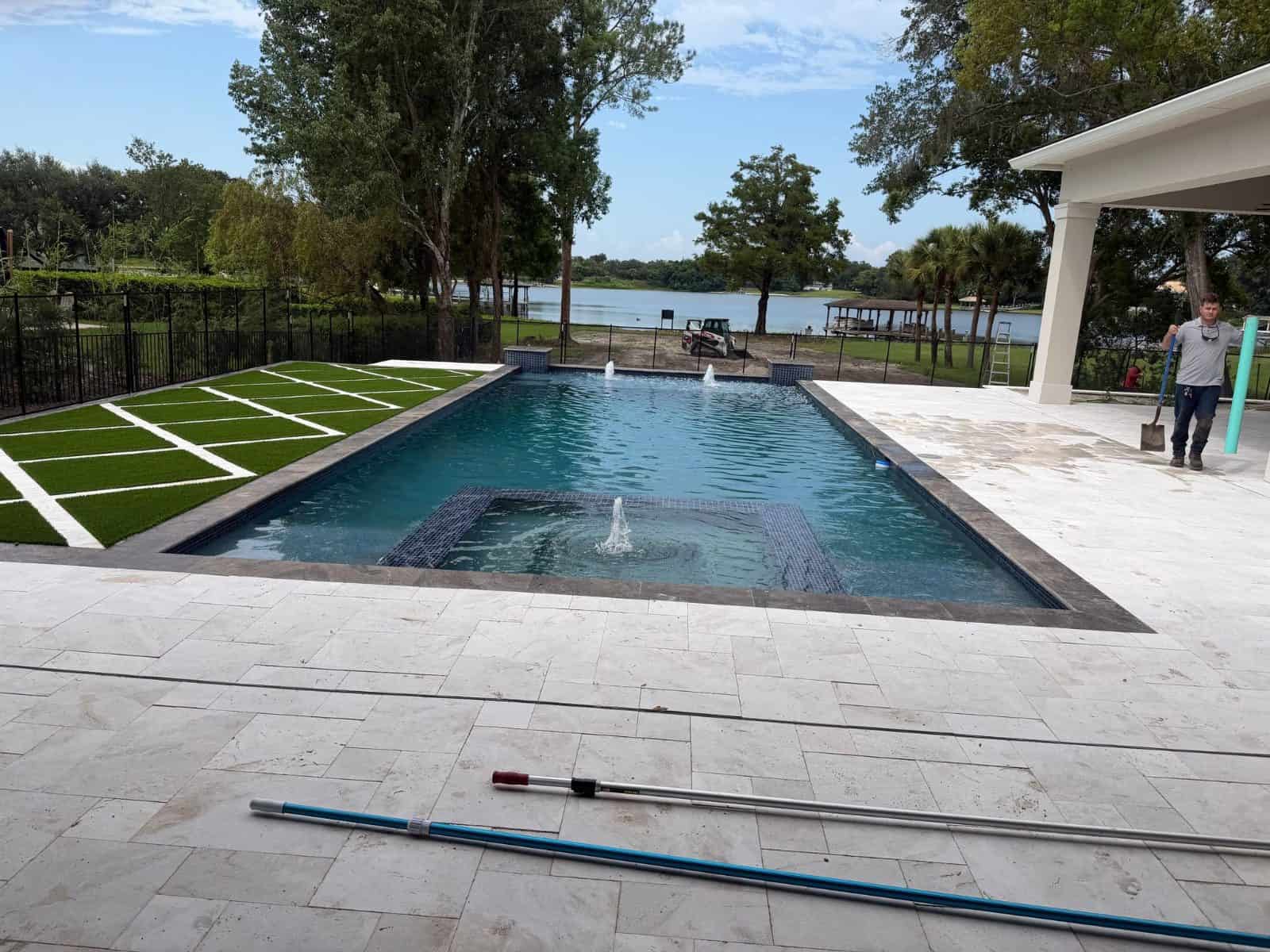


Winter Park Lakefront Pool Cost
Lakefront pools on the chain typically land in our Signature tier ($175,000 to $325,000), our most-built tier, or our Monument tier ($325,000 to $1,000,000+). Slopes, stepped terraces, tight access, tree protection, and edge details push projects up the range. Replacing an existing pool adds $8,000 to $20,000 for demolition. Every project starts with a paid design phase that produces the 3D design and site plan the city’s review requires. Compare bids with our guide on how to compare pool proposals.
Our Process for Winter Park Lakefront Homes
- Welcome call. Goals, any existing pool, historic designation, and whether you want a screen enclosure, since it changes the review path.
- On-site design consultation. We walk the lot to the water and study grade, trees, side-yard access, and neighbors’ sightlines.
- The Signature Experience. Custom 3D design from our design studio, engineering coordination, the City of Winter Park submittal and permits, construction with a dedicated project manager, real-time project tracking and proactive updates, and a final walkthrough.
Winter Park Lakefront Pool FAQs
Does a lakefront pool in Winter Park need Planning and Zoning Board approval?
Not always. A pool without a screen enclosure that meets all of the city’s lakefront criteria can be approved through administrative staff review. A screen enclosure, a new structure, or anything that falls outside the criteria sends the project to the Planning and Zoning Board for a public hearing with notice to adjacent waterfront owners. We design with that path in mind from the start.
How far from the lake does my pool have to be?
For single-family homes, the setback is the average of neighboring waterfront setbacks within 200 feet or 50 feet, whichever is greater, measured from the ordinary high water elevation. An unscreened pool and deck no more than three feet above natural grade may sit at 50 feet. The board can approve less than the neighborhood average, but not less than 50 feet.
Can I have an infinity edge pool on a Winter Park lake?
Often, yes, but the design has to respect the three-foot deck height limit at the lakeside edge. The city’s code says the limit cannot be met by adding a negative edge catch basin or retaining walls in front of the main deck. We set the deck elevation to comply first, then design the vanishing edge around it.
Can my new pool go where the old one was?
Sometimes. If the existing pool meets current setbacks, the location usually works. If it sits closer to the water than today’s rules allow, the Planning and Zoning Board has limited authority to approve replacement, but the new pool cannot make the nonconformity worse. We review the survey and existing conditions before demolition so there are no surprises.
My home is historic. Does that change anything?
It can. Winter Park requires a certificate of review for additions and alterations to properties on its historic register, and homes in local districts such as College Quarter or Virginia Heights East have added design review. We check with the city’s planning staff early to confirm whether your pool scope triggers it and plan the schedule accordingly.
Client Reviews
★★★★★
“They just finished building our pool and I could not be happier! The entire team was professional with great communication throughout the entire process. Highly recommend to anyone looking to build a pool!” -Logan Schell
★★★★★
“Working with the team at Southern Pool Designs has been such a great experience. They are incredibly professional and always so quick to respond. I totally recommend them if you’re looking for a reliable team to work with!.” -Daniela Hurtado Dolz
★★★★★
“Great company with a solid reputation for quality and professionalism. Paul is a pleasure to work with, friendly, knowledgeable, and attentive. Their pricing is also reasonable, and it’s clear they take pride in delivering reliable, well-done work.” -Devon Martin
Start Your Winter Park Lakefront Project
Southern Pool Designs has built custom pools in Florida since November 1997, with more than $100 million in pool projects completed. We are a Florida Certified Pool Contractor (CPC1461548), licensed and insured, rated 5.0, BBB A+, and members of FSPA and GOBA. Call our Sanford design studio at (407) 339-5800 or book your welcome call to talk about your lakefront property.